The Road by Cormac McCarthy—Summary, Themes, and Literary Significance
Introduction
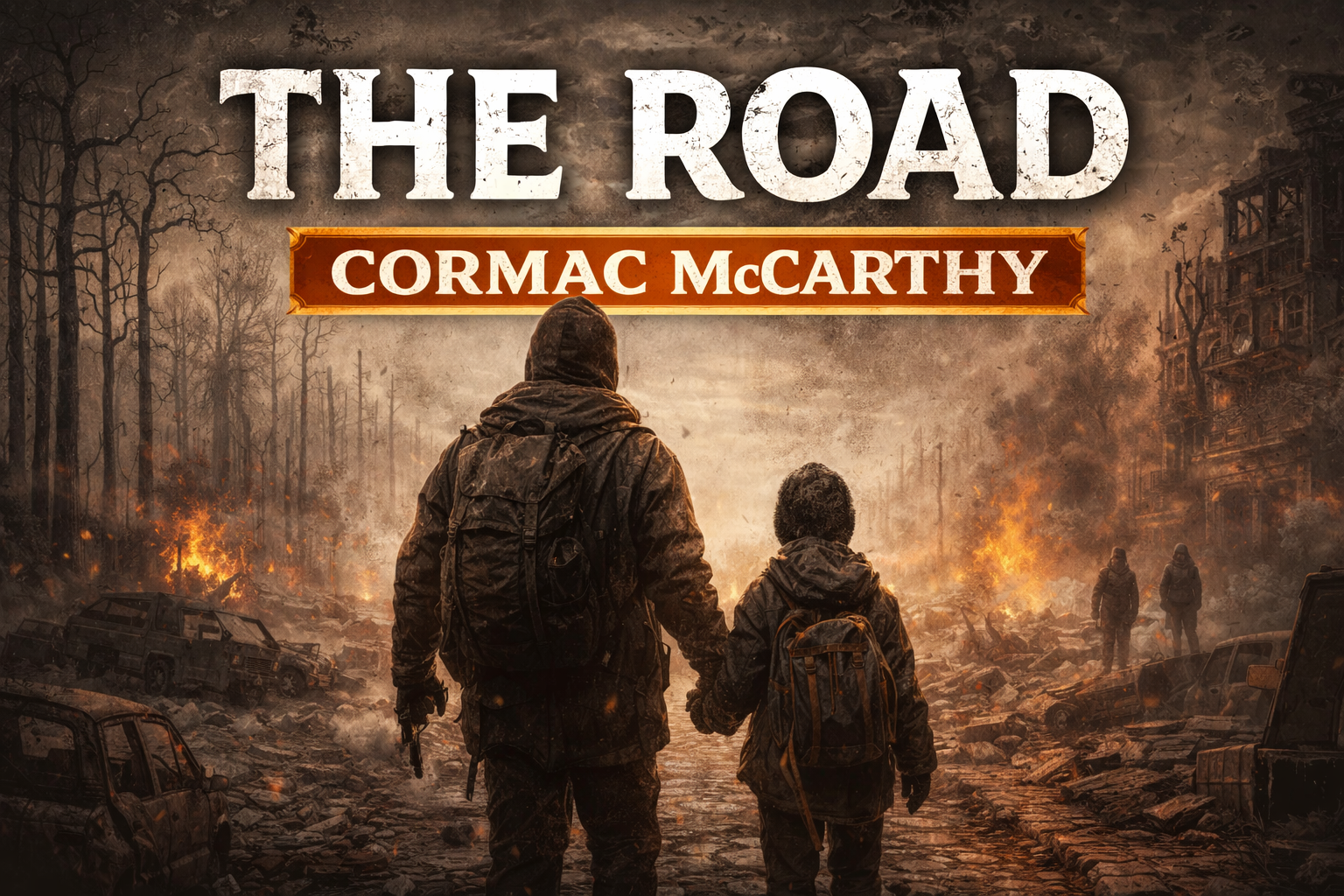
The Road is a post-apocalyptic novel written by American author Cormac McCarthy and published in 2006. Widely regarded as one of the most powerful literary works of the 21st century, the novel explores survival, morality, and human connection in a world devastated by an unnamed global catastrophe.
The book won the Pulitzer Prize for Fiction (2007) and the James Tait Black Memorial Prize, cementing its place as a modern classic. A film adaptation starring Viggo Mortensen and Kodi Smit-McPhee was released in 2009, further expanding its cultural impact.
Overview of the Story
A World After Collapse
The novel takes place in a bleak future where an unspecified disaster has destroyed civilization. The Earth is covered in ash, sunlight is blocked, vegetation has died, and animal life is extinct. Civilization has collapsed, and most survivors have descended into brutality, cannibalism, and lawlessness.
Amid this devastation, a father and his young son travel south along abandoned roads, hoping to find warmth and safety near the coast.
Plot Summary
The story follows the father and son as they journey through a ruined America pushing a shopping cart filled with their few remaining possessions. Food is scarce, temperatures are freezing, and danger is everywhere.
The father:
- Carries a revolver with only two bullets
- Suffers from illness and exhaustion
- Is determined to protect his son at any cost
The boy:
- Represents innocence and moral conscience
- Believes in helping others
- Repeatedly asks whether they are “the good guys”
They encounter:
- Cannibals who imprison people as food
- Abandoned towns and burned forests
- A hidden underground bunker filled with supplies
- A man struck by lightning
- Evidence of extreme human cruelty
Throughout the journey, the father teaches his son that they are “carrying the fire”, a metaphor for goodness, morality, and human compassion.
Eventually, the father’s health deteriorates beyond recovery. After his death, the boy remains with the body for several days before encountering a family that still retains humanity. Trusting them, he chooses to continue living—symbolizing hope beyond despair.
Themes and Symbolism
1. Survival vs. Humanity
The novel questions whether survival is meaningful without morality. While many characters abandon ethics, the father and son strive to remain “good.”
2. Fatherhood and Love
At its core, The Road is a story about parental devotion. The father’s love gives meaning to existence in a meaningless world.
3. Hope in Hopelessness
Even in total devastation, the novel insists that kindness and moral choice still matter.
4. Civilization and Its Collapse
The story reflects on how thin the line is between civilization and savagery when societal structures disappear.
Writing Style and Structure
McCarthy’s prose is:
- Sparse and minimalist
- Largely devoid of quotation marks
- Rhythmic and poetic
- Emotionally intense
This stripped-down style mirrors the barren world of the novel and enhances its emotional impact.
Critical Reception
The novel received universal acclaim.
- Pulitzer Prize for Fiction (2007)
- Named among the best books of the 21st century
- Selected for Oprah’s Book Club
- Frequently cited as one of the greatest post-apocalyptic novels ever written
Critics praised its emotional depth, philosophical weight, and haunting realism.
Film and Graphic Novel Adaptations
Film (2009)
- Directed by John Hillcoat
- Starring Viggo Mortensen and Kodi Smit-McPhee
- Faithful adaptation with strong performances
- Filmed in real post-industrial locations
Graphic Novel (2024)
- Illustrated by Manu Larcenet
- Widely praised for visual storytelling
- Retains the emotional gravity of the original text
Cultural and Literary Significance
The Road is often discussed in relation to:
- Climate change fiction
- Post-apocalyptic literature
- Moral philosophy
- Environmental collapse
- Human resilience
It is frequently compared to works by Orwell, Camus, and Atwood for its philosophical depth and existential themes.
Conclusion
The Road is not just a story about the end of the world—it is a meditation on love, morality, and what it means to remain human when everything else is gone.
Its haunting imagery, emotional intensity, and timeless questions make it one of the most important novels of modern literature. The father and son’s journey reminds readers that even in the darkest times, humanity can survive through compassion, courage, and hope.
Frequently Asked Questions (FAQ)
What is The Road about?
A father and son struggle to survive in a post-apocalyptic world while trying to preserve their humanity.
Who wrote The Road?
Cormac McCarthy.
When was The Road published?
2006.
Did it win awards?
Yes. It won the Pulitzer Prize for Fiction in 2007.
Is The Road based on climate change?
While not explicitly stated, it is often interpreted as an environmental warning.
Is there a movie adaptation?
Yes, released in 2009 starring Viggo Mortensen.