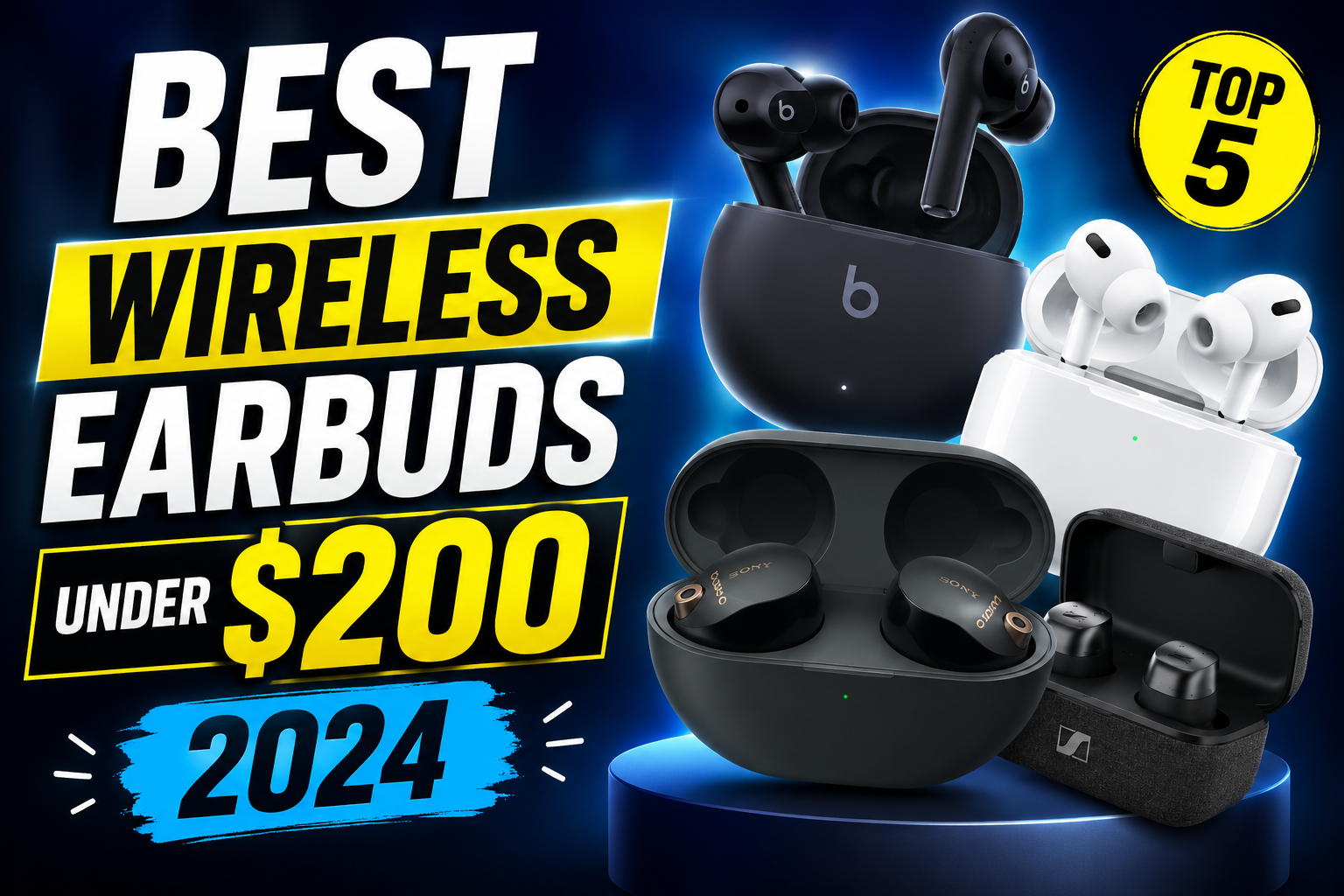
Best Wireless Earbuds Under 200 Dollars 2024- COMPLETE GUAIDANCES
INTRODUCTION
The wireless earbud market in 2026 is the most competitive it has ever been. What was once considered a luxury reserved for $300-plus flagship models — adaptive active noise cancellation, hi-resolution audio codecs, multipoint Bluetooth connectivity, and intelligent sound personalization — is now standard equipment in earbuds costing well under $200. Improved Bluetooth chipsets, smarter noise-cancellation algorithms, and fierce competition among manufacturers have driven innovation without inflating prices, making this the golden era for budget-conscious audio enthusiasts.
Whether you are a daily commuter looking to drown out the noise of trains and buses, a remote worker who needs crystal-clear call quality during video meetings, a fitness enthusiast demanding sweat-resistant durability, or simply a music lover seeking rich, detailed sound without breaking the bank, there is a pair of wireless earbuds under $200 in 2026 built precisely for your lifestyle.
This guide reviews the top models available right now, breaks down the key features to look for, and gives you everything you need to make a confident, well-informed purchasing decision.
WHY THE UNDER-$200 MARKET IS BETTER THAN EVER IN 2026
Just three years ago, spending under $200 on wireless earbuds meant making significant compromises. You might get decent sound but weak noise cancellation, or good ANC but poor battery life, or long battery life but a clunky companion app. In 2026, those trade-offs have largely disappeared.
Several factors are driving this improvement. First, Bluetooth 5.3 and 5.4 chipsets are now widely available at low manufacturing cost, delivering faster, more stable wireless connections with lower latency. Second, xMEMS solid-state drivers — a technology previously confined to premium audio products — are trickling down into the mid-range segment, enabling remarkable sound clarity from very small drivers. Third, machine learning-based ANC systems are being licensed by more manufacturers, meaning that effective adaptive noise cancellation is no longer the exclusive territory of Sony and Bose.
The result is a market where spending $100 to $200 gets you genuinely impressive performance that rivals products costing twice as much just two years ago. Brands like Anker, Nothing, JBL, and Creative are pushing established giants to raise their game, and the consumer is the clear winner.
TOP WIRELESS EARBUDS UNDER $200 IN 2026
1. SONY WF-1000XM5 – Best Overall Pick
Price: Approximately $199 (frequently on sale for less)
Battery Life: 8 hours per charge, 36 hours total with case
Codec Support: LDAC, AAC, SBC
ANC: Adaptive, environment-sensing
Multipoint: Yes (two devices simultaneously)
Water Resistance: IPX4
With the newer Sony WF-1000XM6 launching in February 2026 at $329, its predecessor — the WF-1000XM5 — has settled into the under-$200 tier and become arguably the best wireless earbud you can buy at this price point. It offers features that many earbuds at double the price struggle to match.
The WF-1000XM5 is powered by Sony’s QN2e noise-cancelling chip, which uses dual noise sensor technology to analyze ambient sound from both outside and inside the earbud, applying precise cancellation that adapts in real time to changing environments. Whether you are sitting on a plane, walking a busy street, or settling into an open-plan office, the adaptive ANC quietly adjusts itself without any input from you.
Sound quality is where this earbud truly excels. LDAC codec support allows wireless streaming at up to 990 kbps — roughly three times the data rate of standard AAC — which makes a genuine, audible difference when listening to lossless music from services like Apple Music, Tidal, or Amazon Music HD. The soundstage is wide, instrument separation is precise, and the tuning leans toward balanced with satisfying bass presence that never overwhelms the midrange.
The eight-millimeter driver delivers detailed, spacious audio that earns the “audiophile-grade” label often applied to it. Eight hours of battery per charge is solid, and the case provides an additional 28 hours, with Quick Charge giving you up to 60 minutes of playback from just five minutes in the case.
Multipoint Bluetooth support allows simultaneous connection to two devices — a smartphone and a laptop, for example — and switching between them is smooth enough for daily professional use. The Sony Headphones Connect app is one of the best in the category, offering a 10-band parametric equalizer, customizable touch controls, and Speak-to-Chat (which automatically pauses playback and activates a transparency mode when you begin speaking).
Best For: Audiophiles, remote workers, frequent travelers, and anyone who wants the widest range of premium features in one package.
2. BOSE QUIETCOMFORT EARBUDS II – Best for Noise Cancellation
Price: Approximately $179
Battery Life: 6 hours per charge, 24 hours total with case
Codec Support: AAC, SBC
ANC: CustomTune adaptive ANC
Multipoint: No
Water Resistance: IPX4
If blocking out the world is your single highest priority, no wireless earbud under $200 does it better than the Bose QuietComfort Earbuds II. Bose’s CustomTune technology is the differentiating factor: on first wear, the earbuds emit a brief chirp and measure the acoustic characteristics of your specific ear canal, then calibrate both the noise cancellation and the sound profile to precisely fit your anatomy. The result is ANC performance that is, by most independent measurements, unmatched at this price range.
Bose’s approach is particularly effective at suppressing a broad frequency range. Where many earbuds excel at cancelling low-frequency rumble — engine noise, air conditioning hum, train vibrations — and struggle with higher-frequency sounds like voices and keyboard clicks, the QuietComfort Earbuds II tackle both with equal effectiveness. Users report that the earbuds make open-plan offices feel like private studios.
Sound quality is refined and balanced, with clean mids, smooth highs, and bass that is full without being exaggerated. The Bose Music app allows adjustment of ANC intensity and access to preset EQ modes. The ergonomic StayHear Max tip system distributes the weight of the earbud across a wider area of the ear, making these one of the most comfortable earbuds available for extended sessions of three hours or more.
The trade-offs are real but tolerable. Six hours of battery per charge is shorter than competitors at this price, and the absence of multipoint Bluetooth is a notable omission for users who regularly switch between devices. There is also no LDAC support, which matters to Android users with lossless music libraries.
Best For: Frequent flyers, commuters, open-office workers, and anyone for whom silencing background noise is the top priority above all else.
3. ANKER SOUNDCORE LIBERTY 4 PRO – Best Value for Money
Price: Approximately $99 (regularly available well under $200)
Battery Life: 11 hours per charge, 47 hours total with case
Codec Support: LDAC, AAC, SBC
ANC: Multi-mode adaptive ANC (reduces low-frequency noise by approximately 30dB)
Multipoint: Yes
Water Resistance: IPX4
The Anker Soundcore Liberty 4 Pro is the value story of 2026. For roughly $99 — half the budget ceiling of this guide — it delivers LDAC hi-res audio, adaptive multi-mode ANC, an 11-hour battery life per charge (47 hours total with the case), and one of the most feature-rich companion apps available on any earbud at any price. It is a package that would have cost $250-plus just three years ago.
The ANC system uses seven sensors per earbud to monitor the environment in real time, adjusting the cancellation mode automatically. In independent testing, the Liberty 4 Pro reduces low-frequency noise by approximately 30 decibels — genuinely impressive for a sub-$100 product and competitive with earbuds costing twice as much. The transparency mode is equally well-executed, allowing natural ambient sound to pass through clearly during conversations without requiring the user to remove the earbuds.
The Soundcore app is where this earbud overdelivers most dramatically. It offers a fully customizable EQ, a personalized hearing test that builds a sound profile tailored to the user’s individual hearing sensitivity, adjustable ANC levels, customizable touch controls, and firmware update management. The companion app is, by most accounts, among the three best in the entire wireless earbud market regardless of price.
Sound quality is tuned for consumer-friendly listening: warm, engaging, and bass-forward without being overwhelming. LDAC support means Android users with hi-res music libraries will hear a genuine improvement over standard Bluetooth audio. The charging case features a smart touch display for controlling ANC and playback without reaching for your phone — a genuinely useful novelty rather than a gimmick.
At 11 hours per charge, the Liberty 4 Pro leads the category in battery life, making it ideal for long-haul travelers and users who go days without convenient access to a charger.
Best For: Budget-conscious shoppers, students, casual listeners, frequent travelers, and anyone who wants maximum features per dollar.
4. APPLE AIRPODS 4 – Best for iPhone Users
Price: Approximately $129
Battery Life: 5 hours per charge, 30 hours total with case (with ANC)
Codec Support: AAC, Apple Lossless (ALAC via Apple devices)
ANC: Active noise cancellation with Adaptive Audio
Multipoint: Apple ecosystem only (iPhone, iPad, Mac, Apple Watch)
Water Resistance: IPX4
For iPhone users, no wireless earbud under $200 integrates with the Apple ecosystem as seamlessly as the AirPods 4. Instant pairing via a single tap when the case is opened near an iPhone, automatic device switching between Apple devices, Siri hands-free voice control, Find My network support, and personalized spatial audio with head tracking — all of these features work without any setup and require no companion app. They simply work, every time.
The AirPods 4 represent a significant upgrade over the third-generation model, introducing active noise cancellation to the standard AirPods lineup for the first time. Apple’s Adaptive Audio mode blends ANC and transparency dynamically based on what the environment requires, making it one of the most intelligent listening modes available on any earbud. Conversation Awareness automatically lowers music volume and adjusts the sound mix when it detects that the user has begun speaking, which is particularly useful during quick in-person exchanges.
Sound quality is clear, open, and well-suited to a wide variety of music genres. The semi-in-ear design — the AirPods 4 do not use ear tips — delivers a more natural, airy sound than fully sealed in-ear designs, though this also means less passive noise isolation when ANC is off.
The primary limitation for non-Apple users is a real one: outside of Apple devices, the AirPods 4 lose most of their smart features and behave like standard Bluetooth earbuds. For Android users, this is not the right choice. For iPhone users, it may be the most naturally satisfying earbud experience available at any price.
Best For: iPhone, iPad, and Mac users who want frictionless ecosystem integration and a lightweight, comfortable daily wear earbud.
5. NOTHING EAR (3) – Best for Style and Balanced Sound
Price: Approximately $149
Battery Life: 8 hours per charge, 40 hours total with case
Codec Support: LHDC, AAC, SBC (Hi-Res Audio certified)
ANC: Adaptive ANC with three modes
Multipoint: Yes
Water Resistance: IP54
Nothing’s Ear (3) earbuds are the most visually distinctive product in this guide, featuring the brand’s signature transparent design through which the internal components — driver, antenna, and circuitry — are visible. It is a design statement that draws attention without apology. Fortunately, the audio performance justifies the looks.
The Nothing Ear (3) delivers a sound signature tuned for clarity and detail rather than bass-heavy enthusiasm. Vocals are clear and well-positioned, treble is extended without harshness, and the midrange is natural and uncolored. LHDC codec support provides hi-res audio streaming at high bitrates for Android users, delivering audible benefits on quality music sources. Hi-Res Audio certification from relevant testing bodies confirms that the hardware can resolve the detail that lossless sources contain.
Adaptive ANC adjusts automatically across three modes — light, moderate, and maximum noise isolation — based on the acoustic environment. It is not quite at the level of Sony or Bose in absolute terms, but it is effective enough for commuting, casual office use, and travel. The low-latency mode, when activated, reduces audio delay to a level suitable for mobile gaming and video streaming without noticeable lip-sync issues.
The eight-hour battery per charge is class-competitive, and 40 hours total with the case is genuinely excellent — making these earbuds one of the best in the category for total playtime. The Nothing X companion app has improved significantly with recent updates, offering EQ customization, ANC adjustment, and personalization options that approach the level of more established apps.
Best For: Style-conscious users, those who prefer balanced neutral sound, mobile gamers, and anyone who wants a premium-looking earbud that stands out from the crowd.
6. JBL LIVE BEAM 3 – Best for Smart Case Features
Price: Approximately $149
Battery Life: 8 hours per charge, 32 hours total with case
Codec Support: AAC, SBC
ANC: Adaptive ANC, effective for low-frequency sounds
Multipoint: Yes
Water Resistance: IPX5
The JBL Live Beam 3 earns its place on this list primarily because of one genuinely innovative feature: a charging case with a built-in touch display. The case screen allows users to control playback, switch ANC modes, adjust volume, and access settings without taking out their phone. For users who frequently change settings on the go, this is more practical than it might initially appear.
Beyond the case, the Live Beam 3 delivers sound quality tuned in JBL’s signature consumer-friendly style: energetic bass, engaging presence in the upper midrange, and clear treble that makes vocals and guitars pop. Multiple EQ presets in the JBL Headphones app include a “Studio” mode for users who prefer flatter, more neutral reproduction. ANC performance is strong for low-frequency sounds — commuter drone, engine noise, and air conditioning hum are handled well — and transparency mode is natural enough for holding brief conversations.
Stabilizing ear wings come in the box and are recommended for workout use, giving the Live Beam 3 practical crossover appeal for active lifestyles. IPX5 water resistance is slightly more protective than the IPX4 rating of most competitors, making these a more confident choice for outdoor exercise.
The notable limitation is the lack of LDAC or aptX codec support, which is a missed opportunity for Android users with hi-res music libraries. For users who stream standard-quality audio from services like Spotify, this will not be a concern.
Best For: Tech enthusiasts, frequent settings-adjusters, commuters, and active users who want versatility in a single package.
7. CREATIVE AURVANA ACE 3 – Best Sound Quality Under $200
Price: Approximately $149
Battery Life: 9 hours per charge, 36 hours total with case
Codec Support: aptX Lossless, LDAC, AAC, SBC
ANC: Hybrid ANC
Multipoint: Yes
Water Resistance: IPX5
Among audio enthusiasts, the Creative Aurvana Ace 3 is the most compelling newcomer to the under-$200 category in 2026. Its hybrid driver system — pairing a solid-state xMEMS driver with a 10mm dynamic driver — delivers a level of detail and precision that outperforms nearly everything else at this price point by a meaningful margin.
The xMEMS driver handles midrange frequencies and treble with exceptional clarity, resolving fine details in recordings — reverb tails, the texture of a bow on violin strings, the precise placement of backing vocals — that competing earbuds at this price tend to smooth over. The dynamic driver handles bass extension with a natural weight and punch that avoids the one-note boom of lesser designs. The combination produces a sound that audiophiles typically associate with much more expensive gear.
Independent lab testing has given the Aurvana Ace 3 a Mimi Device Quality Score (MDAQS) of 4.9 — among the highest recorded for any earbud at any price. The inclusion of Mimi Sound Personalization takes this further: a built-in hearing test builds a custom EQ profile calibrated to the user’s individual hearing sensitivity across frequencies, which can make a significant and immediately audible difference.
For Android users, aptX Lossless codec support is a rare and valuable feature at this price, delivering CD-quality or better audio wirelessly over compatible connections. LDAC is also supported, giving users options across multiple hi-res streaming formats.
Best For: Audiophiles, hi-res audio enthusiasts, and anyone who prioritizes sound quality above all other features.
KEY FEATURES TO CONSIDER WHEN BUYING WIRELESS EARBUDS UNDER $200
Sound Quality and Codec Support
The Bluetooth codec your earbuds use determines how much audio information survives the wireless transfer from your phone to your ears. SBC is the baseline standard — reliable but limited. AAC is significantly better and the priority for iPhone users, as Apple devices support it natively at high quality. LDAC, developed by Sony, streams at up to 990 kbps and is the gold standard for Android users with hi-res music libraries, delivering audibly richer detail than AAC or SBC. aptX Lossless, available on the Creative Aurvana Ace 3, can stream at true CD quality when both the phone and earbud support it.
For casual Spotify or YouTube listening, codec differences are minor. For dedicated music listening with lossless sources, LDAC or aptX Lossless support is meaningfully worthwhile.
Active Noise Cancellation
Not all ANC is equally effective. Adaptive ANC — which continuously monitors your environment and adjusts the cancellation in real time — is considerably more useful than fixed-level ANC, which applies the same cancellation regardless of conditions. Bose and Sony consistently lead the category in ANC depth and frequency range, while Anker, JBL, and Nothing have all made significant strides in bringing effective adaptive ANC to lower price points.
Consider your primary use environment: low-frequency noise (planes, trains, traffic) is easier to cancel than high-frequency sound (voices, keyboard clicks). If office use is the priority, look for earbuds with strong high-frequency cancellation. If travel is the focus, nearly any adaptive ANC system will serve you well.
Battery Life
Battery life in the under-$200 category ranges from five hours (AirPods 4 with ANC) to eleven hours (Anker Liberty 4 Pro) per charge, with total case battery life between 24 and 47 hours. Using ANC continuously typically reduces earbud battery life by 15 to 25 percent compared to ANC-off ratings, so check the ANC-on figure when comparing models.
Fast charging is a practical feature worth prioritizing. Most models in this guide offer at least one hour of playback from five to ten minutes of charging—invaluable before a commute or flight when the case was inadvertently left uncharged.
Fit, Comfort, and Build Quality
Comfort is the most underrated specification in earbud reviews. An earbud that measures perfectly in a lab but creates pressure or irritation after ninety minutes of wear is a failed product for daily use. Look for earbuds that include multiple ear tip sizes (extra-small through large), ergonomic shells designed to distribute weight across the ear, and designs that account for different ear anatomies.
IPX4 water resistance is the minimum useful rating for workout use and incidental exposure to rain and sweat. IPX5 (JBL Live Beam 3, Creative Aurvana Ace 3) provides slightly better protection. IP54 (Nothing Ear 3) adds dust resistance alongside water protection.
Software and App Support
A well-designed companion app can meaningfully enhance the utility of any earbud. Key app features to look for include a parametric or graphic equalizer for sound customization, adjustable ANC intensity and modes, customizable touch control assignments, firmware update management, and multipoint Bluetooth pairing controls. Sony’s Headphones Connect app and Anker’s Soundcore app are the category benchmarks. JBL’s Headphones app and Nothing’s Nothing X app have improved significantly in recent updates.
Multipoint Bluetooth — the ability to maintain simultaneous connections to two devices and switch seamlessly between them — has become an important practical feature for users who regularly move between a work laptop and a personal phone. All models in this guide, except the Bose QuietComfort Earbuds II support multipoint.
REAL-WORLD USER INSIGHTS FROM 2026
Across community forums, verified buyer reviews, and independent testing in 2026, several consistent patterns emerge about what real-world users value most in wireless earbuds under $200.
Comfort duration matters more than peak specifications. Users who are initially dazzled by technical performance often return to rate comfort as the deciding factor in whether earbuds remain in daily rotation six months after purchase. Earbuds that cause fatigue or discomfort after ninety to one hundred twenty minutes are frequently abandoned regardless of their audio quality.
ANC quality gap is real but narrowing. Two years ago, the gap between Sony and Bose ANC and everyone else was significant. In 2026, Anker, Nothing, and JBL have reduced that gap substantially, and for everyday commuting and casual office use, the difference is less consequential than it once was. For demanding noise environments like long-haul flights, Sony and Bose still hold a meaningful edge.
Sound preference divides strongly by music genre. Users who primarily listen to hip-hop, EDM, electronic, and pop music consistently rate earbuds with bass-forward tuning (JBL Live Beam 3, Beats options) more highly. Classical, jazz, acoustic, and vocal-heavy listeners lean toward neutral or balanced tuning (Sony WF-1000XM5, Creative Aurvana Ace 3, Nothing Ear 3). Matching earbud tuning to listening habits is one of the most reliable predictors of long-term satisfaction.
App ecosystems increasingly determine loyalty. Users who invest time in customizing EQ profiles, ANC settings, and touch controls through a companion app become significantly more committed to a brand. Anker’s Soundcore app has gained a particularly strong following for its depth of personalization features.
Multipoint Bluetooth is a quality-of-life upgrade that users almost universally appreciate once they have experienced it, and notice negatively when it is absent. It is worth prioritizing for any user who regularly switches between a laptop and a phone during a workday.
HOW TO CHOOSE THE RIGHT EARBUDS FOR YOUR NEEDS
If you use an iPhone and want seamless integration, choose the Apple AirPods 4. Nothing else in this price range matches the depth of ecosystem integration with iPhone, iPad, Mac, and Apple Watch.
If you want the best all-around performance, choose the Sony WF-1000XM5. It offers the broadest combination of strong ANC, hi-res LDAC audio, multipoint Bluetooth, and a mature companion app at the $200 price point.
If blocking noise is your absolute top priority, choose the Bose QuietComfort Earbuds II. CustomTune ANC and the broader frequency range of its noise cancellation system make it the strongest choice for demanding noise environments.
If you want the most features for the lowest spend: Choose the Anker Soundcore Liberty 4 Pro. At approximately $99, it delivers LDAC audio, adaptive ANC, 11-hour battery life, and one of the best companion apps in the category.
If sound quality is your primary criterion: Choose the Creative Aurvana Ace 3. Its hybrid xMEMS driver system delivers audio detail and precision that outperforms everything else under $200, and Mimi Sound Personalization tailors the output to your individual hearing.
If design and style matter to you: Choose the Nothing Ear (3). The transparent design is genuinely distinctive, the balanced sound signature suits a wide range of music, and 40 hours of total battery life is class-competitive.
CONCLUSION
The best wireless earbuds under $200 in 2026 have raised the bar dramatically. Premium features like adaptive noise cancellation, LDAC hi-res audio, multipoint Bluetooth, and intelligent sound personalization are all available well within this budget, and the competition among brands has made every corner of the market more compelling.
The Sony WF-1000XM5 remains the strongest all-around option at the $200 ceiling — its combination of LDAC audio, adaptive ANC, multipoint Bluetooth, and the Headphones Connect app is difficult to beat. The Bose QuietComfort Earbuds II leads in pure noise cancellation. The Anker Soundcore Liberty 4 Pro is the most impressive value proposition in the category. The AirPods 4 are the obvious choice for iPhone users. The Creative Aurvana Ace 3 satisfies the audiophile. And the Nothing Ear (3) turns heads without compromising on performance.
Identify your primary use case, match it to the model that prioritizes those strengths, and you will find that a sub-$200 earbud in 2026 can genuinely compete with — and in some areas exceed — what flagship models offered just a few years ago. You do not need to spend more than $200 to enjoy genuinely excellent wireless audio in 2026.
Also read more about : MobilesRus: The Best Destination for Smartphones, Accessories, and Mobile Services